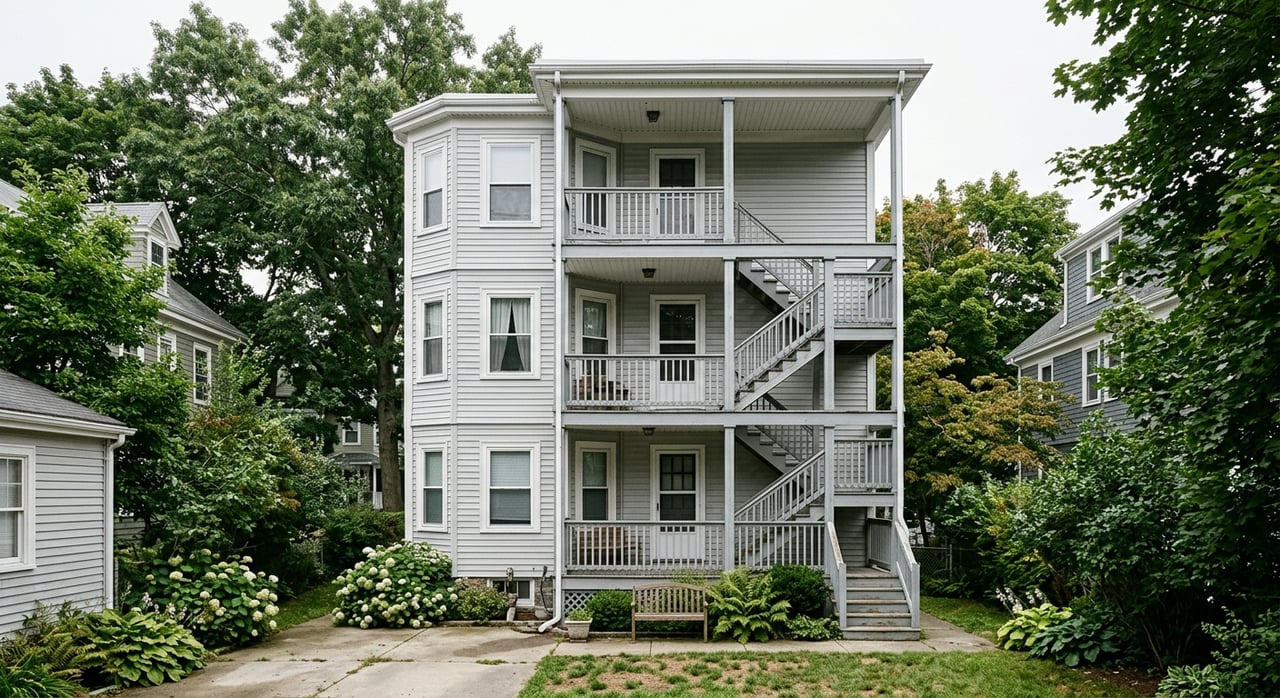
New Bedford Triple-Decker Cash Flow: How to Run the Numbers
May 21, 2026
May 21, 2026
Wondering whether a New Bedford triple-decker actually cash flows, or just looks good on paper? You are not alone. If you are comparing owner-occupied house hacking, a straight investment purchase, or your next small multi-family buy, the numbers can feel simple at first and messy fast. The good news is that with the right rent range and a few local cost benchmarks, you can pressure-test a deal before you get too far. Let’s dive in.
New Bedford gives you a market where renter demand matters. Census data shows the city has 101,318 residents, an owner-occupied housing rate of 40.3%, and a median gross rent of $1,137. That renter-heavy profile helps explain why multi-family properties stay on the radar for both small investors and owner-occupants.
Still, you should not underwrite a triple-decker using one citywide rent figure alone. Bedroom count, unit condition, location within the city, utility setup, and flood exposure can all change the real math. In New Bedford, a triple-decker deal needs a range-based approach, not a single rent guess.
In Massachusetts, a standard triple-decker is generally treated as a residential three-family property. The Massachusetts Department of Revenue property code guide places three-family homes in code 105. That matters because tax treatment starts with how the property is classified.
If the parcel includes mixed-use features, the analysis can change. For a pure residential triple-decker, though, your starting point is the residential side of the tax structure. That keeps your early underwriting cleaner and more realistic.
The smartest way to run the numbers is to bracket income from conservative to more market-driven. In New Bedford, the spread between affordability benchmarks and current asking-rent averages is wide enough to change the whole deal.
Here are three useful rent reference points from the research:
For most triple-deckers, 2-bedroom and 3-bedroom units are the most relevant comps for a rough first pass. Census median gross rent is helpful for broad market context, but it should not replace bedroom-specific underwriting.
To make this practical, assume a three-unit building where all units rent at the same level. That is not how every building performs, but it gives you a fast way to test the opportunity.
If all three units rent at HUD’s 2-bedroom fair market rent of $1,527, gross scheduled rent is about $4,581 per month.
If all three units rent at the current Apartments.com 2-bedroom average of $1,963, gross scheduled rent is about $5,889 per month.
If all three units rent at the current Apartments.com 3-bedroom average of $2,446, gross scheduled rent is about $7,338 per month.
Right away, you can see the issue. A deal that looks only okay at one rent level may look strong at another. That is why New Bedford triple-deckers should be underwritten as a range of outcomes.
On the expense side, New Bedford’s FY2025 Annual Comprehensive Financial Report lists the residential tax rate at $11.31 per $1,000 of assessed value. For a standard residential triple-decker, that is the rate to begin with.
The city also has a Community Preservation Act surcharge. According to the city’s Community Preservation Plan, the surcharge is 1.5% of the real estate tax bill, with the first $100,000 of taxable value exempt for residential property.
Using the research report’s example of a $600,000 assessment, the annual tax math looks like this:
That is a useful local baseline, but remember that assessors value property at fair cash value as of January 1 each year. Your actual tax carry will depend on the current assessment and classification.
For financing, the research report uses Freddie Mac’s 6.37% benchmark for a 30-year fixed mortgage as of May 7, 2026. At that rate, each $100,000 borrowed costs about $623.54 per month in principal and interest.
If you borrow $480,000 on a purchase, your monthly principal and interest is about $2,993. When you add the sample monthly tax and CPA total of $573, your combined monthly debt service plus taxes comes to about $3,566.
This is not a full loan quote, of course. Your actual payment will depend on rate, down payment, loan type, and lender terms. But as a fast screening tool, it gives you something grounded and local.
Using the three income cases above, and subtracting only the sample monthly taxes plus debt service, here is the rough picture:
| Rent Scenario | Gross Monthly Rent | Taxes + Debt Service | Remaining Before Other Expenses |
|---|---|---|---|
| HUD 2BR case | $4,581 | $3,566 | $1,015 |
| Market 2BR case | $5,889 | $3,566 | $2,323 |
| Market 3BR case | $7,338 | $3,566 | $3,772 |
This table is useful because it shows how much room is left before vacancy, insurance, repairs, maintenance, management, utilities, and reserves. That remaining amount is not your profit. It is the space you still have to work with.
Every clean-looking pro forma can fall apart if you assume 100% collection forever. A proper underwriting sequence starts with gross scheduled rent, then subtracts vacancy and credit loss before you move on to operating expenses.
That step matters in any market, but especially in an older multi-family housing stock where turns, deferred maintenance, and collection interruptions can show up quickly. Even a strong New Bedford deal should be tested against some downtime and income loss.
After vacancy, you need to layer in operating costs. The research report points to the big categories you should review:
Utilities deserve special attention in New Bedford. The city’s ACFR notes that water and sewer are billed quarterly, unpaid charges can become liens on the tax bill, and FY2026 budgets reflect rate increases. Wastewater spending was funded by a 3% rate increase, and the water fund reflected the last of five annual 8.4% increases across base and commodity charges.
That means you should not treat utilities as a throwaway estimate. Ask which utilities are separately metered, which ones the owner pays, and whether recent bills show a stable pattern.
Insurance is another line item that can swing more than buyers expect. In New Bedford, flood risk is highly property-specific. FEMA notes that flood insurance is separate from homeowners insurance, and Special Flood Hazard Areas are the mapped high-risk zones.
For coastal or low-lying parcels, you should check the FEMA flood map early. A building that looks attractive on price and rent can become a very different deal once flood insurance enters the picture.
If you want a practical framework, keep it simple and repeatable:
This approach helps you avoid two common mistakes. The first is using a rent number that is too optimistic. The second is ignoring local carrying costs that can chip away at the spread.
If you are shopping for a triple-decker in New Bedford, the biggest takeaway is simple: the deal lives or dies in the range. A property may look solid at current market asking rents, but only average if real rents come in closer to HUD benchmarks. That gap is large enough to affect your down payment strategy, renovation plan, and comfort level with risk.
For owner-occupants, the same logic applies. If you plan to live in one unit and rent the others, small differences in rent and expenses can meaningfully change your monthly housing cost. Running conservative numbers upfront helps you avoid buying based on best-case assumptions.
If you want help pressure-testing a New Bedford multi-family, comparing recent sales, or making sense of what a specific triple-decker could realistically produce, reach out to Luis Rodrigues. You will get practical guidance, local market insight, and a straightforward conversation about whether the numbers make sense.






Luis is here to help you throughout your entire home buying and selling process. Trying to do it all on your own can be burdensome. He will find you homes within your price range, help you find buyers, assist you with paperwork, and more.